


Last updated – June 2026
This guide summarizes key labeling requirements for organic products sold in the U.S. market. For complete information about labeling, please consult the U.S. Department of Agriculture (USDA) organic regulations (7 CFR 205 Subpart D).
NOTE: The information in this guide does not preempt Food and Drug Administration; USDA, Food Safety and Inspection Service; or Alcohol and Tobacco Tax and Trade Bureau (TTB) labeling regulations or label approval requirements. Please see TTB’s Alcohol Beverage Labeling Guidelines for the labeling of organic alcohol beverages.
USDA Labeling Categories for Organic Products
Certified organic products imported into the United States from a country with an organic equivalence arrangement (trade partner) must follow the USDA organic labeling rules (see 7 CFR 205.300(c)). These rules apply to both products in retail packaging and ingredients or raw commodities in non-retail packaging. This fact sheet explains the USDA organic labeling categories and other labeling requirements.
The term “organic” may only be used in labeling of raw or processed agricultural products (including ingredients) that have been produced and handled in accordance with the USDA organic regulations, or an organic certification program the USDA has deemed equivalent. The USDA organic regulations allow different labeling categories depending on the content of organic agricultural ingredients. The product composition requirements are outlined in 7 CFR 205.301(a)-(d). The labeling categories are:
- 100% Organic: all ingredients must be 100% organic and processing aids must be certified organic.
- Organic: 95% of product must be certified organic; nonorganic ingredients must meet restrictions.
- Made with organic ingredients: 70% of product must be certified organic; nonorganic must meet restrictions.
The USDA Seal
The USDA seal is optional but is permitted on USDA certified organic products and on eligible organic products imported into the United States under an equivalence arrangement. The specific requirements for using the USDA seal are outlined in 7 CFR 205.311.
There are two versions of the USDA seal -brown and green or black and white -and either may be used with or without the registered trademark ® symbol.
- Brown and green on a white background (jpg)
- Black and white on a white or transparent background (gif)
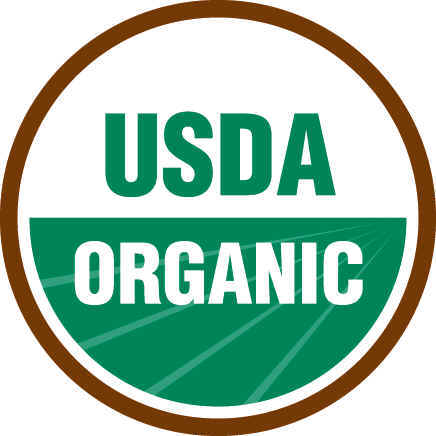
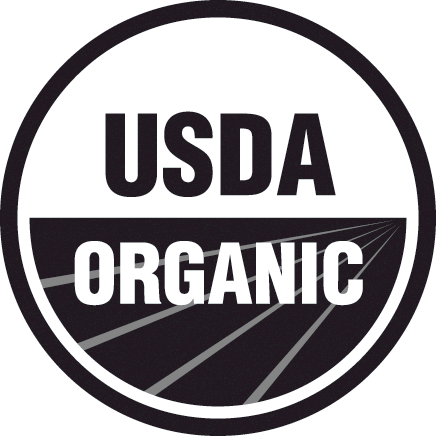
The USDA seal may only be used on product labeled as “100% Organic” or as “Organic” (95% or greater organic content). Certified grape wines that contain added sulfites, even if they contain at least 95% organic content, are also prohibited from being labeled with the USDA seal.
The logo, seal, or other identifying mark of the certification body may be displayed on the label. If a label has both the USDA seal and the certification body’s logo, the certification body’s logo must not be larger or more noticeable than the USDA seal.
Products with less than 95% organic content, including those labeled “Made with Organic” ingredients, must not use the USDA seal. Certification body logos may be used on products labeled “Made with Organic” ingredients as long as the logo does not misrepresent the finished product as organic. Labels for products in the “Made with Organic” ingredients category may name up to three ingredients or food groups on the principal display panel but cannot use the phrase “made with organic ingredients.” Examples: Cereal made with organic oats, apples, and cinnamon; wine made with organic grapes.
The Ingredient Statement
Agricultural products packaged with labels making “Organic” or “Made with Organic” ingredients claims must identify each organic ingredient in the ingredient statement with the word, “organic,” or with an asterisk or other reference mark which is defined below the ingredient statement to indicate the ingredient is organically produced. Water and salt, when included as ingredients, cannot be labeled as organic and are excluded from the calculation of percentage organic content.
The “Certified Organic by …” Statement
The USDA organic regulations in 7 CFR Part 205 Subpart D focus on labeling and require that packaged products include a statement naming the certification body, such as, “certified organic by [name of certification body that certified the processor or distributor of the finished product].” This statement must be placed on the information panel directly below the information identifying the handler or distributor of the product. Only using a certification body’s identification code (e.g., AA-BIO-001) is not compliant with the U.S. requirements.
If the product imported into the United States is not labeled for retail sale, then use of the “certified organic by …” statement is optional. Nonretail labels or containers used to ship or store certified organic agricultural products must meet the labeling requirements outlined in 7 CFR 205.307.
Table 1: Summary of USDA organic retail product labeling categories and corresponding label elements.
| Label Elements | 100% Organic | Organic (minimum 95%) | Made with Organic ingredients (minimum 70% & wines with added sulfites) |
|---|---|---|---|
| Organic ingredients identified in the ingredients statement | Optional if the product is labeled as 100% Organic | Required | Required |
| Certified Organic by [certification body name] statement | Required | Required | Required |
| USDA seal allowed on the label (and/or foreign equivalent) | Yes, use is optional | Yes, use is optional | Prohibited |
| Certification body seal or logo allowed on the label *Must be of equal or smaller size than the USDA seal | Yes, use is optional | Yes, use is optional | Yes, use is optional |
Example Labels for Retail Containers
100 Percent Certified Organic Content
Figure 1 (pdf): Example of a compliant retail label in the 100 percent organic category. The cereal contains 100% certified organic content, as shown in the ingredients statement. Relevant USDA organic regulations: 7 CFR 205.303.
Organic, Minimum 95 Percent Certified Organic Content
Figure 2 (pdf): Example of a compliant retail label in the organic category. The organic cereal contains 95 percent or greater certified organic content, as shown in the ingredients statement. Relevant USDA organic regulations: 7 CFR 205.303.
Made with Organic Ingredients, Minimum 70 Percent Certified Organic Content
Figure 3 (pdf): Example of a compliant retail label in the “Made with Organic” ingredients category. The label claims “made with organic oats, apples, and cinnamon” (this statement is optional). The other ingredients are non-organic. Relevant USDA organic regulations: 7 CFR 205.304.
Example Label for Nonretail Containers
Figure 4: Example of a non-retail organic product label for a raw commodity, organic olive oil. Relevant USDA organic regulations: 7 Code of Federal Regulations 205.307.
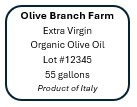
Labels must include identification of the product as “organic” and the lot number, shipping identification, or other unique information that links the container to audit trail documentation. Audit trail documentation must also include the lot number or other unique information that links the container to the last certified operation that handled the product.
Labels for Wine Exports to the U.S. Under Equivalence
The USDA organic regulations for wine production and labeling are unique from other organic schemes. Wine imported into the United States under an equivalence must comply with certain production practices and labeling requirements in the USDA organic regulations. This means that some wine labeled as “organic” in the exporting country may need to be labeled differently to be sold in the U.S. market. For example, wine with added sulfites and certified organic under another scheme can only be labeled as “made with organic grapes” for the U.S. market. Only certified wine without added sulfites may be labeled as “organic” wine in the U.S. market.
The United States Alcohol, Tobacco, Tax and Trade Bureau (TTB) has additional requirements for all imported alcohol beverages, including products making organic claims. TTB also has an organic wine labeling guide that illustrates compliant versus noncompliant labeling for organic wine.
Table 2: USDA Wine Labeling Categories
Summary of USDA labeling requirements for different categories of wine imported under an organic equivalence and sold in the U.S. market.
| Wine Factors | Organic Wine | Wine Made with Organic Grapes |
|---|---|---|
| Contains only USDA (or equivalent) certified organic grapes | Required | Required |
| May contain both organic and non-organic grapes | Prohibited | Prohibited |
| Added sulfites (sulfur dioxide only, maximum 100 ppm) | Prohibited | Allowed |
| USDA organic seal (or foreign equivalent) on the label | Optional | Prohibited |
| Certified Organic by [certification body name] statement on the information panel of the label | Required | Required |
| Certification body seal or logo* allowed on the label *Must be of equal or smaller size than the USDA seal | Optional | Optional |